Scaling Generative AI (GenAI) features presents unique challenges. While creating an initial proof-of-concept might seem straightforward, managing the inherent complexity of a growing GenAI feature in production is significantly harder. Once live, applications inevitably encounter edge cases, performance bottlenecks, and unexpected costs. Estimating these factors pre-launch is difficult; predicting how a feature might degrade after several iterations is even more challenging.
So a GenAI feature needs close monitoring after it ships. This article covers techniques to build and keep confidence in a GenAI application while it keeps changing. The ideas come from DevOps, software engineering, product management, and science, stacked into practices that hold stability today and leave room for what comes next.
The Challenge of Scaling GenAI
Currently, there isn't a universally accepted roadmap for building production-grade GenAI features. While pioneering companies are emerging, their specific methodologies often remain proprietary. OpenAI offers guidance on optimizing LLM accuracy, suggesting a progression from prompting to Retrieval-Augmented Generation (RAG), fine-tuning, and potentially combining these methods.
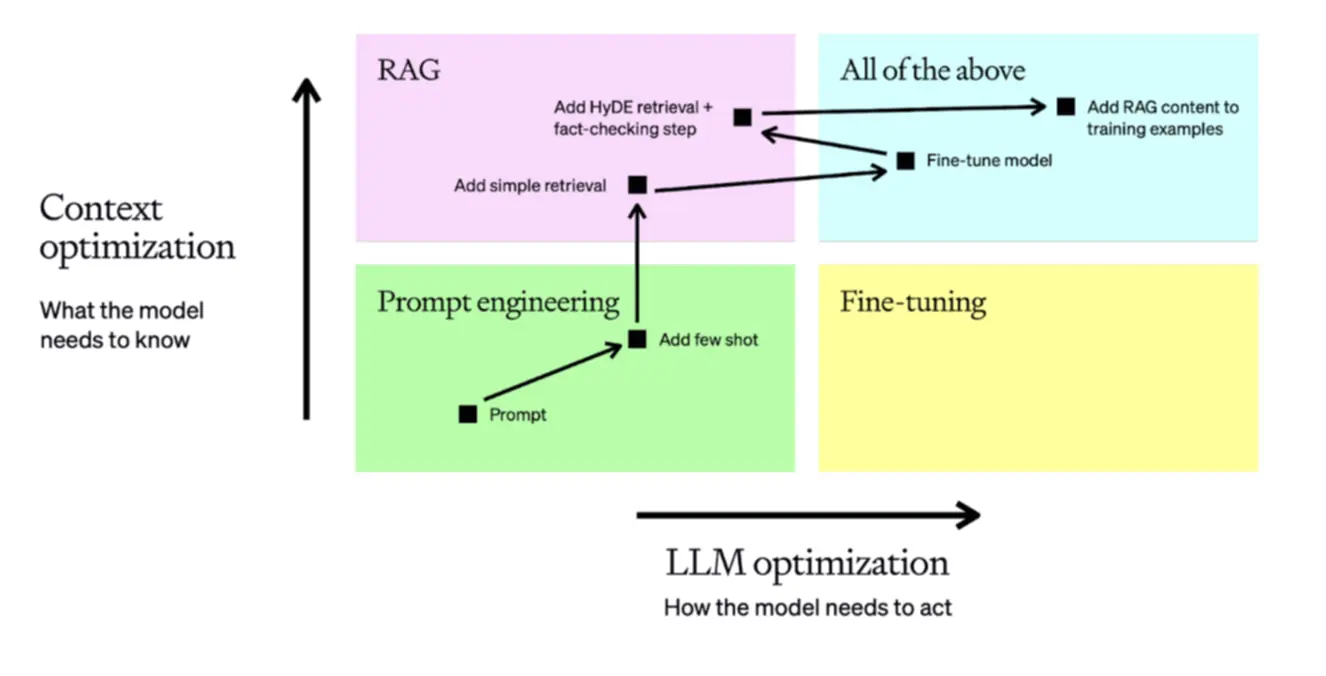
OpenAI's suggested path: Prompting -> RAG -> Finetuning
However, practical experience reveals pitfalls. Teams can get lost in endless prompt engineering debates, struggle with choosing the right model, or face unexplained performance degradation even without new deployments. The linear path suggested by OpenAI often feels more complex in reality, perhaps better represented as an iterative, sometimes chaotic, cycle:

A more realistic, iterative view of GenAI development
The hardest part is building a reliable foundation, especially in how you construct prompts. Without that solid base, scaling attempts fall apart and every new addition can trigger cascading failures, because the system is fragile to begin with. Simple use cases are easy to build on day one, and the frustration shows up later, as the feature grows.
So the main job when scaling AI is tracking improvements and regressions rigorously. That sounds simple, but it means watching the feature from several angles at once. There is no single silver bullet. We rely on a combination of processes, each one testing a different aspect, and together they give us enough confidence to move forward.
Techniques for Sustainable Growth
1. Observability
Observability matters for any production system, and GenAI features are no exception. At a minimum, track these metrics:
- Usage Rate (e.g., uses_per_minute): Detect anomalies like sudden traffic spikes (potential DDoS) or drops (feature outage or declining usage).
- Failure/Retry Rate (e.g., retry_count, fail_count): Monitor the frequency of errors. Exceeding a defined threshold should trigger downtime or degradation alerts.
- Token Consumption (e.g., tokens_used): Track usage to monitor costs. Set alerts if tokens_used * price_per_token exceeds budget thresholds.
These metrics can be captured through various means:
- Logs: Ideal for uses_per_minute, as many logging platforms (e.g., Coralogix) offer built-in anomaly detection.
- Bug Tracking Providers: Suitable for retry_count/fail_count, allowing configured alerts (e.g., on 1st, 10th, 100th occurrence) with associated stack traces and payloads.
- Databases: Useful for tokens_used, facilitating dashboard integration and cost analysis sharing.
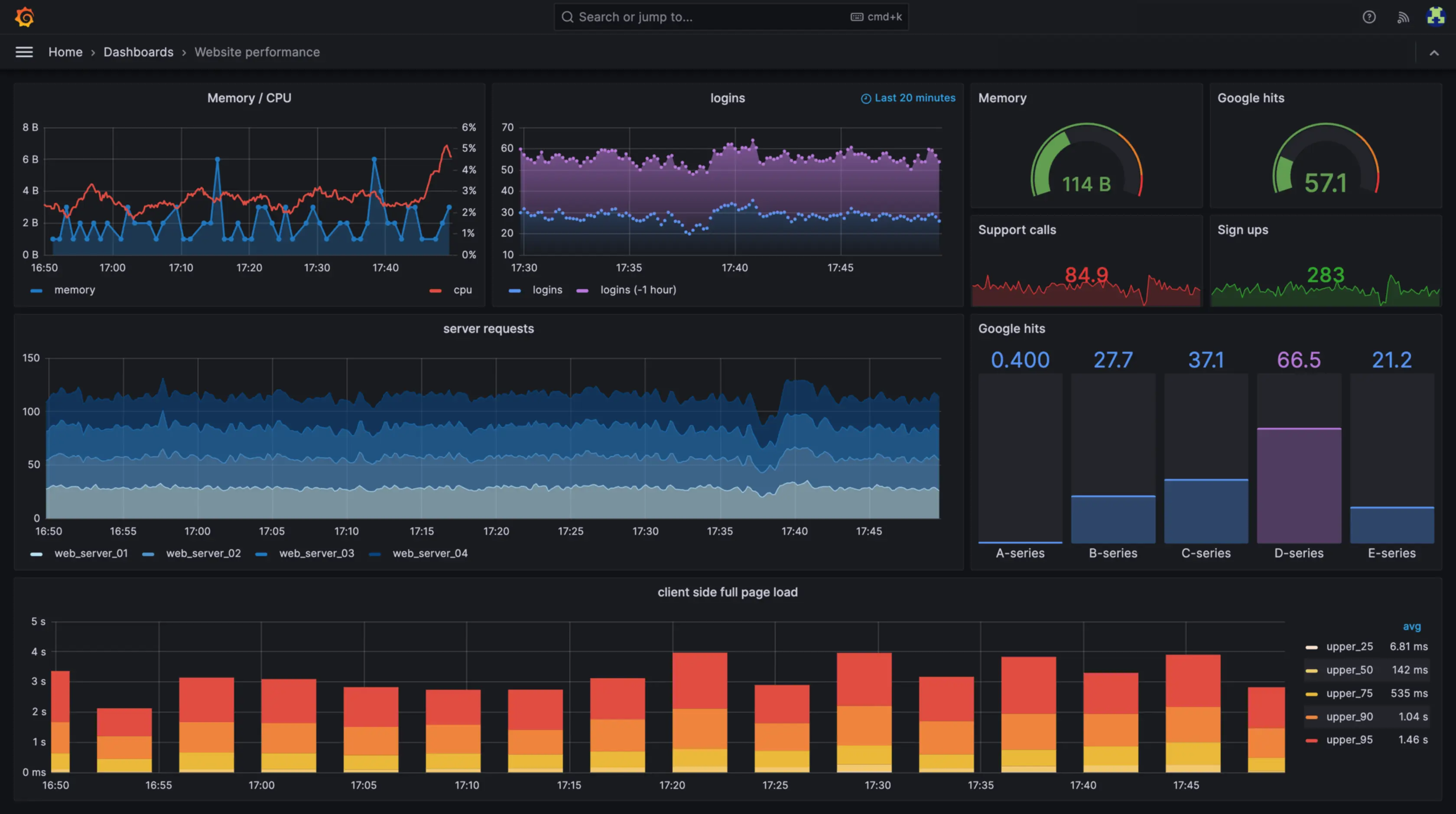
Example observability dashboard showing key metrics
While these operational metrics confirm the feature is running and within budget, they don't guarantee it's delivering the intended value.
2. Success Metrics
The more directly your success metric relates to the GenAI's function, the better. If a direct metric is elusive, use a combination of indirect metrics that collectively build confidence. For example, if an AI feature assists users in filling out forms, success could be measured by a decrease in average form completion time *and* an increase in form submission conversion rates.
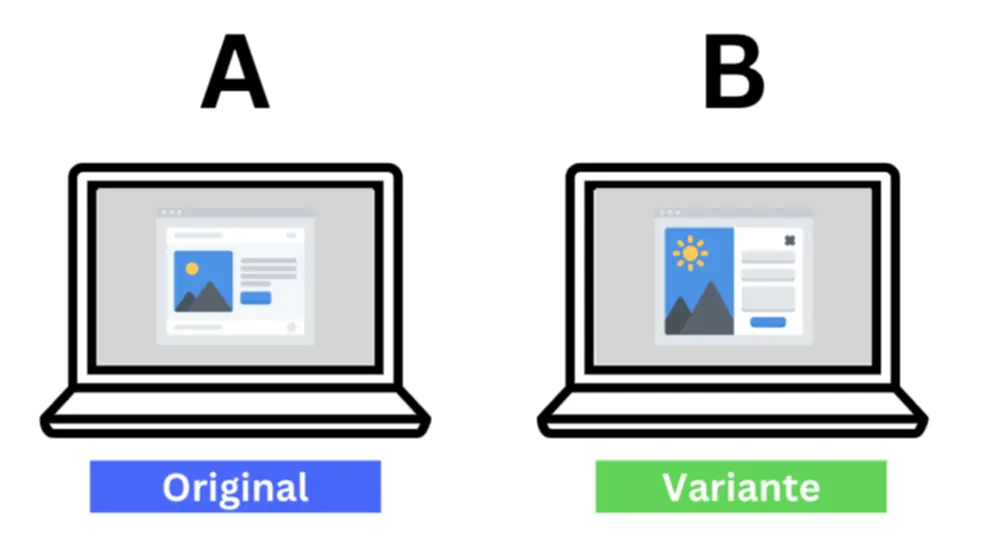
Example A/B test comparing metrics with and without the AI feature
You can evaluate these success metrics with A/B testing, canary releases, gradual rollouts, or plain user interviews.
If the AI works in a domain where you already have historical data (reviewing past actions, running analyses), you get a much stronger option. Run the AI's task on historical inputs and compare its output ("blind" prediction) against the outcome you already recorded.
Regardless of the method, ensure you have at least one clear success metric, tied as directly as possible to the AI's purpose.
There is not news in both topics, thats exactly I keep it short, but we can thinking in the future without even the basics like theses topics. These first two steps ensure the feature is running and providing business value. But how do we maintain confidence when refactoring prompts, changing models, or modifying surrounding code *before* risking a production deployment?
3. Benchmarking: Ensuring Consistent Behavior
GenAI moves fast. Changing the underlying LLM version or provider is often necessary to stay competitive or to use new capabilities. But simply swapping models isn't safe; even upgrading from a cheaper to a more expensive model can lead to worse performance on specific tasks.
No model is best at everything; each one carries its training data and post-training alignment. That is why benchmarking is essential: it verifies that the behaviors you care about survive a model or prompt change.
There are plenty of public benchmarks (HELM, MT-Bench), and specialized platforms like Arena Intelligence Inc. (LMArena). Public benchmarks are useful but have one big limitation: they almost certainly don't cover your specific use case, your data, or your proprietary know-how.
If your GenAI feature provides a competitive advantage, relying solely on public benchmarks is insufficient. You need to create your own benchmark suite. Fortunately, if you've implemented success metrics and logging (steps 1 & 2), this becomes much easier.
For engineers, a benchmark is essentially an integration test: given specific inputs, expect specific outputs or behaviors. Gather diverse examples from your production logs, particularly those flagged with your success metric, and codify them into automated tests.

Conceptual representation of benchmark tests with input/output pairs
However, there's a catch: LLMs are often non-deterministic. The same input can yield different responses. How can we build reliable tests around this inherent variability?
4. Ensuring Consistent
LLMs vary by nature and they can "hallucinate". Trying to remove that entirely changes what the technology is. So we accept the variability and build techniques to manage the uncertainty that comes with it. Scientific validation methods are a good place to steal ideas from:
4.1 Replication
Scientific Principle: Repeating experiments under identical conditions multiple times.
Application: Run each benchmark test case multiple times (e.g., 5-10 times). Adopt a pessimistic stance: if the test fails even once, consider the overall test run a failure for that specific input.
- Tip: Avoid running identical requests consecutively. LLM providers might return cached responses while still charging for computation. Introduce randomization or delays (e.g., 30 seconds) between identical requests.
4.2 External Replication
Scientific Principle: Independent labs reproducing the same work.
Application: Leverage the abundance of LLM providers. Since different models (even those with similar capabilities) are trained differently, they act as somewhat independent "labs." Send the same input to multiple providers or models. Here, an optimistic view can be useful: if *at least one* provider produces the desired successful outcome for a specific test case, it indicates that the task is achievable, potentially identifying the best model for that case. The test for that input could pass if any provider succeeds.
4.3 Controlled Variation
Scientific Principle: Testing the same hypothesis across different, slightly modified scenarios.
Application: Remember that LLMs operate on tokens. Minor changes to input text can drastically alter output. Research (like Apple's 2023 paper on LLM robustness) shows that simple modifications like using synonyms or rephrasing questions (e.g., passive voice) can significantly impact performance on standardized tests.
Illustration showing how small input changes affect LLM outputs
This sensitivity poses a production challenge. Mitigate it by applying controlled variations to your benchmark tests. Take existing test inputs and automatically generate variations: change the tone, rephrase sentences, substitute synonyms, while preserving the core meaning.
- Caution: This can exponentially increase test volume and cost. Apply this technique judiciously, perhaps focusing on core feature tests and running them less frequently (e.g., only for major releases) primarily to detect regressions in robustness.
4.4 Statistical Validation
Once you have a sufficiently large and diverse set of test results (from replication, external replication, and controlled variation), you can apply statistical methods. Calculate aggregate success rates, confidence intervals, p-values, or Bayesian credible intervals to quantify the confidence level in a new model version or prompt strategy compared to the baseline.
Resilience Techniques: Handling Failures Gracefully
1. Preparing for Critical Errors
LLM providers and even self-hosted models can face stability and scaling challenges. Predicting load and ensuring consistent performance is difficult. Therefore, applications integrating LLMs must be resilient to transient issues like provider downtime or intermittent response failures. Implement standard distributed system resilience patterns:
- Retries: Automatically retry failed requests (with exponential backoff and jitter).
- Timeouts: Set reasonable timeouts for API calls to prevent indefinite hangs.
- Asynchronous Processing: Use background jobs or queues for non-critical LLM tasks to avoid blocking user requests.
- Rate Limiting: Implement client-side rate limiting to avoid exceeding provider quotas and handle
429 Too Many Requestserrors gracefully. - Trackable Requests: Assign unique IDs to each request for easier debugging and tracing across systems.

Print of error 500
2. Guardrails: Preventing Undesirable Behavior
LLMs are good at tasks that need subjective judgment, the kind of work that used to require a human in the loop. But they can also be manipulated ("prompt injection") or carry biases. Engineers have to add guardrails to reduce these risks.
2.1 Prompt Injection
Prompt injection, where malicious user input alters the LLM's intended behavior, is a real threat. Since LLM inputs are often derived from user-generated text, this vulnerability is inherent. Defense strategies include:
- Input Size Limits: Restrict the length of user-provided input to reduce the surface area for injection attacks.
- Keyword/Phrase Filtering: Block known malicious patterns or keywords.
- NLP-Based Detection: Use pre-trained Natural Language Processing models to identify suspicious input patterns (e.g., instructions hidden within text).
- Using an LLM to Protect an LLM: Employ a separate, simpler LLM call specifically designed to sanitize or analyze user input for potential threats before passing it to the main task LLM.
2.2 Output Validation and Control
Don't blindly trust LLM outputs. Implement checks and constraints:
- Templating: Instead of asking the LLM to generate fully formed text containing sensitive data, ask it to return a template string with placeholders (e.g., `"Hi #{user_name}, your order #{order_number} is confirmed."`). Then, populate the template with verified data from your system. This can also mitigate biases (e.g., tone variations based on inferred gender from names).
- Business Logic Validation: Apply domain-specific rules to the LLM's output. If extracting a salary from a job description, validate that the extracted value is within an expected range, non-negative, not null, etc.

3. Chaos Monkey for LLMs
Inspired by Netflix's Chaos Monkey for infrastructure, intentionally inject failures into your LLM integration during testing. Simulate scenarios like:
- Artificially low rate limits.
- Intermittent API errors (5xx responses).
- High latency responses.
- Injecting known prompt injection patterns into simulated user inputs.
This is how you find out whether your retries, timeouts, and guardrails actually hold up when things go wrong.
Preparing for the Future
1. Fine-tuning Preparedness
Fine-tuning may become necessary as your feature matures, typically to achieve a minimal acceptable success rate unattainable with general models or to significantly boost performance on a highly specific, critical task. If you're unsure whether you need fine-tuning, you probably don't yet.
Preparing for it is simple: log the relevant data. Store the inputs you sent to the LLM, the outputs you got back, and the matching success flag (from your success metrics). Here is the structure used in ActiveGenie:
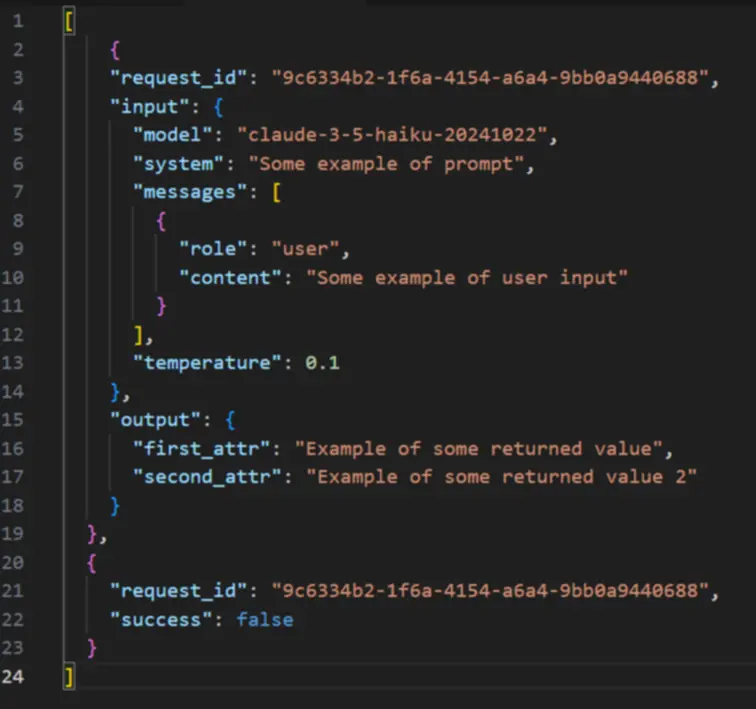
Example data structure logging input, output, and success status
Choose a consistent structure that makes sense for your application. The key is capturing the context (input), the result (output), and the evaluation (success/failure).
2. Local Development Environment
New developers and teams should be able to maintain the feature without friction. Leaning on live LLM APIs for local development does not scale and it costs money on every run. Use the logged historical input/output pairs to build realistic mocks or stubs, so people can work locally without hitting an external service every time.
3. Provider Decoupling
The list of AI providers changes weekly. A competitor might release a breakthrough model, or your current provider could change pricing or terms. Build your application so these shifts don't hurt. Use an abstraction layer, either an open-source tool like LiteLLM that gives you one interface across multiple providers, or your own internal adapter. Then switching providers is a small code change.
Conclusion
Building and scaling GenAI features is complex, especially in these early days without established best practices or mature tooling. The techniques here: observability, success metrics, benchmarking, rigorous validation, resilience patterns, and future-proofing, give you layers to manage that complexity.
This layered strategy is the philosophy behind ActiveGenie, an open-source project I'm building to make LLM integration less painful. The goal is to be a "lodash for LLMs": reusable components for these common problems, so teams can spend their time on business value instead. The code is public if you want to see how these ideas look in practice.

ActiveGenie, the lodash for LLMs
When releasing new versions of GenAI features, we may never get the deterministic precision of traditional code coverage. But applying these techniques consistently gives us a quantifiable confidence value: an assessment of whether a new release is likely better, worse, or inconclusive compared to the previous one. That is enough to keep iterating.
We should focus on being "less wrong" each day rather than striving for an elusive "perfectly right".