The framework around the model is worth more than the frontier model itself.
The framework around the model is worth more than the frontier model itself.
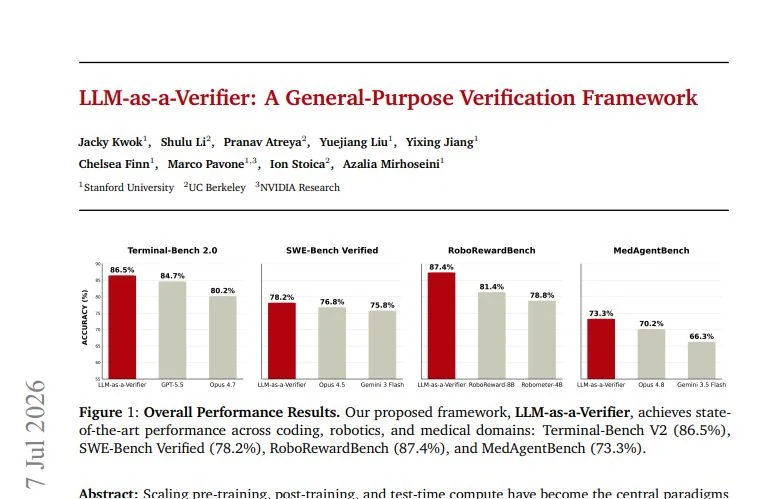
Researchers from Stanford, UC Berkeley, and NVIDIA Research showed that you can beat GPT-5.5, Claude Opus 4.8, and Gemini 3.1 Pro without upgrading to a better model. Instead, they used a tournament technique where candidate responses face off in 1v1 matchups.
It's called Probabilistic Pivot Tournament, and it works like this:
- The model generates N candidate responses for the same prompt.
- A fast initial pass assigns a baseline score to each response.
- Based on that ranking, responses split into two groups: the top performers (the pivot group) and the rest.
- Each non-pivot is paired against every pivot, while pivots compete among themselves in 1v1 duels.
- The duel outcomes create the final ranking, selecting the single best response.
It isn't fast, and it isn't cheap. But it works: 86.5% on Terminal-Bench V2 compared to 84.7% for GPT-5.5, and 78.2% on SWE-Bench Verified compared to 76.8% for Opus 4.5.
This is what changes everything: top performance on a task no longer relies solely on the frontier model, but on the harness and engineering around it.
If you have followed my work for a while, you already know this tournament approach. It's the core method ActiveGenie uses to deliver consistent results. I wrote the initial tournament logic back on February 3, 2025, nearly a year and a half ago.
There is one key difference: ActiveGenie uses political debate while the paper uses logprobs. That topic deserves a dedicated post of its own.
Until then, try ActiveGenie. Stop relying on expensive frontier models alone. Pair a leaner model with the right system architecture instead.
Paper: LLM-as-a-Verifier